RISK FACTORS AND CLINICAL OUTCOMES OF FEBRILE URINARY TRACT INFECTION FROM CEFTRIAXONE-RESISTANT ENTEROBACTERACEAE IN CHILDREN
DOI:
https://doi.org/10.55374/jseamed.v10.297Keywords:
febrile urinary tract infection, ceftriaxone-resistant Enterobacteriaceae, antibiotic resistance, prevalence, Maternal risk factors, clinical outcomesAbstract
Background: Febrile urinary tract infection (FUTI) is one of the most common bacterial infections in children. It is a major cause of hospitalization and long-term renal complications, with Enterobacteriaceae being the main pathogens. Third-generation cephalosporins, particularly ceftriaxone, are widely used as first-line empirical antibiotics because of their broad-spectrum activity. Previous studies have shown that the prevalence of ceftriaxone-resistant Enterobacteriaceae is increasing both domestically and internationally. However, these studies have reported inconsistent findings regarding differences in clinical manifestations and treatment outcomes between ceftriaxone-resistant and ceftriaxonesusceptible FUTI.
Methods: We conducted a retrospective cohort study of pediatric patients diagnosed with Enterobacteriaceae-associated FUTI at Naresuan University Hospital, a tertiary hospital in the lower northern part of Thailand, from November 1, 2018, to October 31, 2024. Patients were categorized into ceftriaxone-resistant and susceptible groups. We analyzed clinical data, laboratory findings, treatment outcomes, and post-infectious imaging.
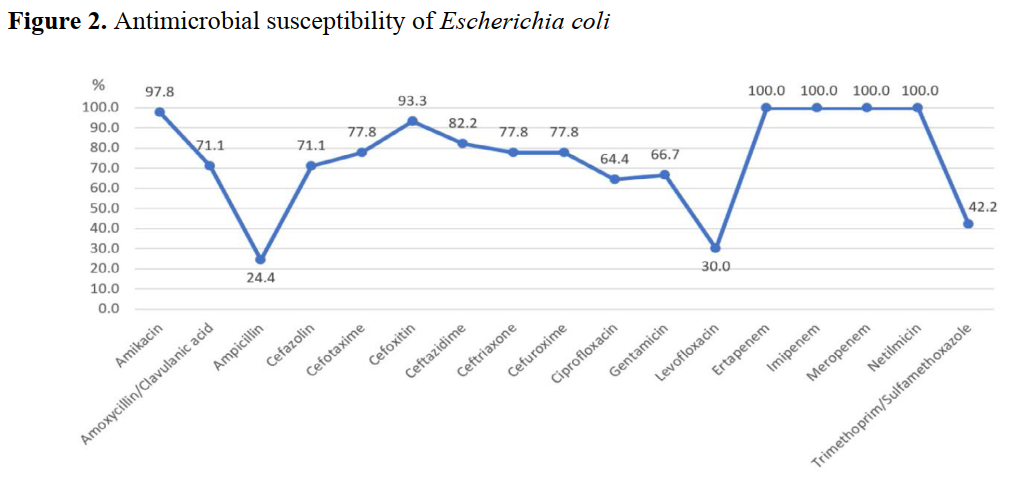
Results: Of the 52 pediatric cases, Escherichia coli was the most common pathogen (86.5%), with 77.8% ceftriaxone sensitivity. Patients with previous antibiotic use within 3 months and a history of hospitalization tended to have ceftriaxone resistance, though the difference was not significant. Moreover, patients with ceftriaxone-resistant FUTI had longer hospital stays and longer durations of intravenous antibiotic therapy; however, these differences were not statistically significant. Patients with FUTI due to ceftriaxone-resistant Enterobacteriaceae were more likely to require a change in antibiotic therapy than those with FUTI due to ceftriaxone-susceptible Enterobacteriaceae.
Conclusion: There is no significant difference in risk factors and treatment outcomes between ceftriaxone-resistant and susceptible Enterobacteriaceae FUTI. This finding indicates that third-generation cephalosporins can be used as an appropriate empirical therapy for community-onset FUTI. However, patients with FUTI should be promptly switched to targeted antimicrobials based on sensitivity results if they deteriorate clinically.
Downloads
Metrics
References
Mattoo TK, Shaikh N, and Nelson CP. Contemporary management of urinary tract infection in children. Pediatrics 2021; 147: e2020012138. DOI: https://doi.org/10.1542/peds.2020-012138
Silva A, Oliveira E, Mak RH. Urinary tract infection in pediatrics: an overview. J Pediatr (Rio J) 2020; 96 (Suppl 1): 65-79. DOI: https://doi.org/10.1016/j.jpedp.2019.10.006
Renko M, Salo J, Ekstrand M, Pokka T, Pieviläinen O, Uhari M, et al. Meta-analysis of the risk factors for urinary tract infection in children. Pediatr Infect Dis J 2022; 41: 787-92. DOI: https://doi.org/10.1097/INF.0000000000003628
Agegnehu A, Worku M, Nigussie D, Lulu B, Tadesse BT. Pediatric febrile urinary tract infection caused by ESBL-producing Enterobacteriaceae species. Biomed Res Int 2020; 2020: 6679029. DOI: https://doi.org/10.1155/2020/6679029
Hassor S, Etinger V, Villacis DS, Houssay M, Bukhari A, Gruber J, et al. A case-control study evaluating risk factors and outcomes of hospitalized children with ESBL-UTI. Clin Pediatr (Phila) 2022; 61: 759-67. DOI: https://doi.org/10.1177/00099228221100064
Vachvanichsanong P, McNeil EB, and Dissaneewate P. Extended-spectrum beta-lactamase Escherichia coli and Klebsiella pneumoniae urinary tract infections. Epidemiol Infect 2020; 149: e12. DOI: https://doi.org/10.1017/S0950268820003015
Al Yousef SA, Younis S, Farrag E, Moussa HS, Bayoumi FS, Ali AM. Clinical and laboratory profile of urinary tract infections associated with extended spectrum β-lactamase producing Escherichia coli and Klebsiella pneumoniae. Ann Clin Lab Sci 2016; 46: 393-400.
Amornchaicharoensuk Y. Clinical characteristics and antibiotic resistance pattern of pathogens in pediatric urinary tract infection. Southeast Asian J Trop Med Public Health 2016; 47: 976-82.
Nieminen O, Korppi M, and Helminen M. Healthcare costs doubled when children had urinary tract infections caused by extendedspectrum β-lactamase-producing bacteria. Acta Paediatr 2017; 106: 327-33. DOI: https://doi.org/10.1111/apa.13656
Ammenti A, Alberici I, Brugnara M, Chimenz R, Guarino S, La Manna A, et al. Updated Italian recommendations for the Diagnosis, treatment and follow-up of the first febrile urinary tract infection in young children. Acta Paediatr 2020; 109: 236-47. DOI: https://doi.org/10.1111/apa.14988
Esposito S, Biasucci G, Pasini A, Predieri B, Vergine G, Crisafi A, et al. Antibiotic resistance in paediatric febrile urinary tract infections. J Glob Antimicrob Resist 2022; 29: 499-506. DOI: https://doi.org/10.1016/j.jgar.2021.11.003
Wang ME, Lee V, Greenhow TL, Beck J, Bendel-Stenzel M, Hames N, et al. Clinical response to discordant therapy in third-generation cephalosporin-resistant UTIs. Pediatrics 2020; 145: e20191608. DOI: https://doi.org/10.1542/peds.2019-1608
Montini G, Tullus K, Hewitt I. Febrile urinary tract infections in children. N Engl J Med 2011; 365: 239-50. DOI: https://doi.org/10.1056/NEJMra1007755
Hari P, Meena J, Kumar M, Sinha A, Thergaonkar RW, Iyengar A, et al. Evidence-based clinical practice guideline for management of urinary tract infection and primary vesicoureteric reflux. Pediatr Nephrol 2024; 39: 1639-68. DOI: https://doi.org/10.1007/s00467-023-06173-9
CLSI. Performance standards for antimicrobial susceptibility testing. 34th information supplement CLSI document M100. Wayne, PA: Clinical and Laboratory Standards Institute; 2024.
Flokas ME, Detsis M, Alevizakos M, Mylonakis E. Prevalence of ESBL-producing Enterobacteriaceae in paediatric urinary tract infections: A systematic review and metaanalysis. J Infect 2016; 73: 547-57. DOI: https://doi.org/10.1016/j.jinf.2016.07.014
Rianthavorn P, Siripen N, Kunnaruk K. Cephalosporins for first febrile urinary tract infection from Enterobacteriaceae with antimicrobial resistance in young children. Acta Paediatr 2021; 110: 2230-2. DOI: https://doi.org/10.1111/apa.15852
Lin Y, Peng Q, Li W, Chen B. Analysis of antibiotic resistance and risk factors of extended-spectrum beta-lactamases-producing Escherichia coli in hospitalized children with community-acquired urinary tract infections. Int Urol Nephrol 2025; 57: 2271-8. DOI: https://doi.org/10.1007/s11255-025-04417-1
Chacha F, Mirambo MM, Mushi MF, Kayange N, Zuechner A, Kidenya BR, et al. Utility of qualitative C-reactive protein assay and white blood cell counts in the diagnosis of neonatal septicemia at Bugando Medical Centre, Tanzania. BMC Pediatr 2014; 14: 248. DOI: https://doi.org/10.1186/1471-2431-14-248
Mushi M, Alex VG, Seugendo M, Silago V, Mshana SE. C-reactive protein and urinary tract infection due to gram-negative bacteria in a pediatric population at a tertiary hospital, Mwanza, Tanzania. Afr Health Sci 2019; 19: 3217-24. DOI: https://doi.org/10.4314/ahs.v19i4.45
Karaaslan A, Kadayifci EK, Atici S, Akkoc G, Yakut N, Öcal Demir S, et al. The clinical efficacy and safety of ertapenem for the treatment of complicated urinary tract infections caused by ESBL-producing bacteria in children. Int J Nephrol 2015; 2015: 595840. DOI: https://doi.org/10.1155/2015/595840
Lee B, Kang SY, Kang HM, Yang NR, Kang HG, Ha IS, et al. Outcome of antimicrobial therapy of pediatric urinary tract infections caused by extended-spectrum β-lactamaseproducing Enterobacteriaceae. Infect Chemother 2013; 45: 415-21. DOI: https://doi.org/10.3947/ic.2013.45.4.415
Downloads
Published
How to Cite
Issue
Section
License
Copyright (c) 2026 Journal of Southeast Asian Medical Research

This work is licensed under a Creative Commons Attribution-NonCommercial-NoDerivatives 4.0 International License.
The Journal of Southeast Asian Medical Research will hold the copyright to all published articles. The publisher's production department handles copyright forms once a manuscript is accepted and scheduled for publication.