ASSOCIATION BETWEEN BODY ROUNDNESS INDEX AND METABOLIC RISK FACTORS FOR CARDIOVASCULAR DISEASE AMONG ACTIVE-DUTY MILITARY PERSONNEL IN THAILAND
DOI:
https://doi.org/10.55374/jseamed.v10.267Keywords:
body roundness index, cardiovascular disease, hypertension, hyperglycemia, hyperlipidemia, hyperuricemiaAbstract
Background: The body roundness index (BRI), which combines waist circumference (WC) and height, is a promising measure of body shape and central obesity. Active-duty members of the Royal Thai Army (RTA) showed an increase in metabolic risk factors for cardiovascular disease (CVD) from 2017 to 2021.
Objective: The study aimed to analyze health examination data of RTA personnel nationwide to evaluate the association between BRI and metabolic risk factors for CVD and assess the effect measure modification of sex on this association.
Methods: We conducted a cross-sectional study in RTA personnel aged 20 to 60 years using health examination data in 2022. BRI was calculated from WC and height and categorized into four groups based on quartiles (1-4). Metabolic risk factors for CVD were defined as having at least one of the following: high blood pressure (BP) (≥ 140/90 mmHg), hyperglycemia (fasting plasma glucose ≥126 mg/dL), high total cholesterol (TC) (≥ 240 mg/dL), hypertriglyceridemia (≥150 mg/dL), and hyperuricemia (≥ 7 mg/dL for men and ≥ 6 mg/dL for women).
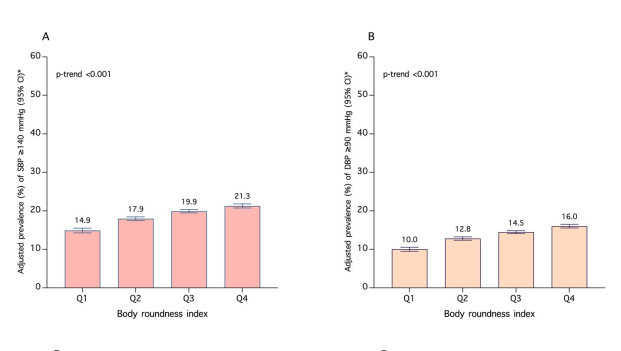
Results: A total of 109,821 RTA personnel were included in the analysis. The overall mean BRI was 3.5 (±1.2), with quartile-specific means of 2.2 (Q1), 3.0 (Q2), 3.6 (Q3), and 5.0 (Q4). Multivariable logistic regression revealed significant associations between BRI and metabolic risk factors for CVD: high BP (adjusted prevalence ratio [APR] 1.18, 1.28, 1.38 for Q2, Q3, Q4), hyperglycemia (APR 1.12, 1.31, 1.67), high TC (APR 1.21, 1.33, 1.25), hypertriglyceridemia (APR 1.27, 1.50, 1.59), and hyperuricemia (APR 1.11, 1.24, 1.26), all compared to Q1 (p-trend < 0.001). Higher BRI quartiles were associated with a greater likelihood of presenting composite metabolic risk factors, especially in the fourth quartile (APR 1.18 for men, 1.23 for women; p for interaction < 0.001).
Conclusion: Our results demonstrate that, among active-duty RTA personnel, a higher BRI is associated with a greater number of metabolic risk factors for CVD. BRI, a measure of central adiposity, is a useful tool for identifying individuals at increased risk of CVD.
Downloads
Metrics
References
Roth GA, Mensah GA, Johnson CO, Addolorato G, Ammirati E, Baddour LM, et al. Global burden of cardiovascular diseases and risk factors, 1990-2019: update from the GBD 2019 study. J Am Coll Cardiol 2020; 76: 2982–3021. DOI: https://doi.org/10.1016/j.jacc.2020.11.010
World Health Organization. Cardiovascular diseases (CVDs) [Internet]. Geneva: World Health Organization; 2021 [cited 2025 Jul 20]. Available from: https://www.who.int/news-room/fact-sheets/detail/cardiovascular-diseases-cvds
World Health Organization. WHO Mortality Database [Internet]. Geneva: World Health Organization; 2021 [cited 2025 Jul 20]. Available from: https://platform.who.int/mortality/themes/theme-details/topics/topic-details/MDB/cardiovascular-diseases
World Health Organization. Obesity [Internet]. Geneva: World Health Organization; 2025 [cited 2025 Jul 20]. Available from: https://www.who.int/news-room/fact-sheets/detail/obesity-and-overweight
Ng M, Gakidou E, Lo J, Abate YH, Abbafati C, Abbas N, et al. Global, regional, and national prevalence of adult overweight and obesity, 1990–2021, with forecasts to 2050: a forecasting study for the Global Burden of Disease Study 2021. Lancet 2025; 405: 813–38. DOI: https://doi.org/10.1016/S0140-6736(25)00355-1
Aekplakorn W. Thai National Health Examination Survey VI (2019-2020) [Internet]. Nonthaburi: Health Systems Research Institute; 2021 [cited 2023 Oct 3]. Available from: https://online.fliphtml5.com/bcbgj/znee/#p=187
Jongcherdchootrakul K, Poovieng J, Hempatawee N, Hatthachote P, Mungthin M, Rangsin R, et al. Rising trends in body mass index and obesity prevalence among young Thai men: a 16-year analysis of new military conscript data (2009–2024). BMC Res Notes. 2026; [Epub ahead of print]. DOI: https://doi.org/10.1186/s13104-026-07650-8
Sakboonyarat B, Pornpongsawad C, Sangkool T, Phanmanas C, Kesonphaet N, Tangthongtawi N, et al. Trends, prevalence and associated factors of obesity among adults in a rural community in Thailand: serial cross-sectional surveys, 2012 and 2018. BMC Public Health 2020; 20: 850. DOI: https://doi.org/10.1186/s12889-020-09004-w
Sakboonyarat B, Poovieng J, Jongcherdchootrakul K, Srisawat P, Hatthachote P, Mungthin M, et al. Rising trends in obesity prevalence among Royal Thai Army personnel from 2017 to 2021. Sci Rep 2022; 12: 7726. DOI: https://doi.org/10.1038/s41598-022-11913-2
Adab P, Pallan M, Whincup PH. Is BMI the best measure of obesity? BMJ [Internet]. 2018;360:k1274. Available from: https://www.bmj.com/content/360/bmj.k1274 DOI: https://doi.org/10.1136/bmj.k1274
Medina-Inojosa JR, Batsis JA, Supervia M, Somers VK, Thomas RJ, Jenkins S, et al. Relation of waist-hip ratio to long-term cardiovascular events in patients with coronary artery disease. Am J Cardiol 2018; 121: 903–9. DOI: https://doi.org/10.1016/j.amjcard.2017.12.038
Thomas DM, Bredlau C, Bosy‐Westphal A, Mueller M, Shen W, Gallagher D, et al. Relationships between body roundness with body fat and visceral adipose tissue emerging from a new geometrical model. Obesity (Silver Spring). 2013; 21: 2264–71. DOI: https://doi.org/10.1002/oby.20408
Yang M, Liu J, Shen Q, Chen H, Liu Y, Wang N, et al. Body roundness index trajectories and the incidence of cardiovascular disease: evidence from the China health and retirement longitudinal study. J Am Heart Assoc 2024; 13: e034768. DOI: https://doi.org/10.1161/JAHA.124.034768
He X, Zhu J, Liang W, Yang X, Ning W, Zhao Z, et al. Association of body roundness index with cardiovascular disease in patients with cardiometabolic syndrome: a cross-sectional study based on NHANES 2009-2018. Front Endocrinol (Lausanne). 2025; 16: 1524352. DOI: https://doi.org/10.3389/fendo.2025.1524352
Somdee T, Somdee T, Yangyuen S, Mungvongsa A, Khiewkhern S, Puapittayathorn T, et al. Screening tools for metabolic syndrome based on anthropometric cut-off values among Thai working adults: a community-based study. Ann Saudi Med 2023; 43: 291–7. DOI: https://doi.org/10.5144/0256-4947.2023.291
Poovieng J, Jongcherdchootrakul K, Srisawat P, Mungthin M, Rangsin R, Sakboonyarat B. Rising trends in current tobacco use among active-duty personnel of the Royal Thai Army in Thailand from 2017 to 2022 and its associated metabolic risk factors for cardiovascular disease in 2022. J Southeast Asian Med Res 2024; 8: e0198. DOI: https://doi.org/10.55374/jseamed.v8.198
Sakboonyarat B, Sangkool T, Poovieng J, Jongcherdchootrakul K, Srisawat P, Hatthachote P, et al. Trends in the prevalence of type 2 diabetes among Royal Thai Army personnel and associated factors from 2017 to 2021. J Southeast Asian Med Res 2023; 7: e0160. DOI: https://doi.org/10.55374/jseamed.v7.160
Sakboonyarat B, Poovieng J, Jongcherdchootrakul K, Srisawat P, Hatthachote P, Mungthin M, et al. Prevalence of hypertriglyceridemia among Royal Thai Army personnel and its related cardiometabolic risk factors, from 2017 to 2021. BMC Public Health. 2022; 22: 1569. DOI: https://doi.org/10.1186/s12889-022-13992-2
Sakboonyarat B, Poovieng J, Jongcherdchootrakul K, Srisawat P, Hatthachote P, Mungthin M, et al. Trends in serum total cholesterol and high total cholesterol prevalence among Royal Thai Army personnel in Thailand, 2017–2022. High Blood Press Cardiovasc Prev 2023; 30: 1–12. DOI: https://doi.org/10.1038/s41598-022-11913-2
Sakboonyarat B, Poovieng J, Srisawat P, Hatthachote P, Mungthin M, Rangsin R, et al. Prevalence, awareness, and control of hypertension and associated factors among Royal Thai Army personnel in Thailand from 2017 to 2021. Sci Rep 2023; 13: 6946. DOI: https://doi.org/10.1038/s41598-023-34023-z
Kunanon S, Chattranukulchai P, Chotruangnapa C, Kositanurit W, Methavigul K, Boonyasirinant T, et al. 2019 Thai guidelines on the treatment of hypertension: executive summary. J Med Assoc Thai 2021; 104: 1729–38. DOI: https://doi.org/10.35755/jmedassocthai.2021.10.12199
Lertsakulbunlue S, Sangkool T, Bhuriveth V, Mungthin M, Rangsin R, Kantiwong A, et al. Associations of triglyceride-glucose index with hyperuricemia among Royal Thai Army personnel. BMC Endocr Disord 2024; 24: 17. DOI: https://doi.org/10.1186/s12902-024-01542-3
Sakboonyarat B, Rangsin R, Mittleman MA. Incidence and risk factors of metabolic syndrome among Royal Thai Army personnel. Sci Rep 2022; 12: 1–11. DOI: https://doi.org/10.1038/s41598-022-19024-8
Linden A, Mathur MB, VanderWeele TJ. Conducting sensitivity analysis for unmeasured confounding in observational studies using E-values: the evalue package. Stata J 2020; 20: 162–75. DOI: https://doi.org/10.1177/1536867X20909696
Liu Y, Liu X, Guan H, Zhang S, Zhu Q, Fu X, et al. Body roundness index is a superior obesity index in predicting diabetes risk among hypertensive patients: a prospective cohort study in China. Front Cardiovasc Med 2021; 8: 736073. DOI: https://doi.org/10.3389/fcvm.2021.736073
Piché ME, Tchernof A, Després JP. Obesity phenotypes, diabetes, and cardiovascular diseases. Circ Res 2020; 126: 1477–500. DOI: https://doi.org/10.1161/CIRCRESAHA.120.316101
Bhupathiraju SN, Hu FB. Epidemiology of obesity and diabetes and their cardiovascular complications. Circ Res 2016; 118: 1723–35. DOI: https://doi.org/10.1161/CIRCRESAHA.115.306825
Downloads
Additional Files
Published
How to Cite
Issue
Section
License
Copyright (c) 2026 Journal of Southeast Asian Medical Research

This work is licensed under a Creative Commons Attribution-NonCommercial-NoDerivatives 4.0 International License.
The Journal of Southeast Asian Medical Research will hold the copyright to all published articles. The publisher's production department handles copyright forms once a manuscript is accepted and scheduled for publication.