INCIDENCE TRENDS, SURVIVAL OUTCOMES, AND PREDICTIVE FACTORS FOR ONE-YEAR SURVIVAL IN ADVANCED PANCREATIC DUCTAL ADENOCARCINOMA: A TEN-YEAR SINGLE-CENTER RETROSPECTIVE STUDY
DOI:
https://doi.org/10.55374/jseamed.v10.284Keywords:
pancreatic cancer, pancreatic ductal carcinoma, survival predictor, overall survival, FOLFORINOXAbstract
Background: Pancreatic cancer remains one of the most lethal malignancies worldwide, with a fiveyear survival rate of less than 10%. Over the past decade, small improvements in survival have resulted from better surgical techniques, new therapies, and advances in systemic treatments. However, the overall prognosis remains poor, as most cases are diagnosed at advanced stages, at which survival rates decline sharply.
Methods: A retrospective review was conducted at the Surin Hospital Cancer Center from January 2015 to January 2025. While overall hospital case trends were evaluated for patients across all stages, the primary survival analysis focused specifically on patients with locally advanced/unresectable and metastatic disease. For this advanced cohort, clinical characteristics and overall survival were evaluated, and independent predictors of one-year survival were identified using multivariable logistic regression.
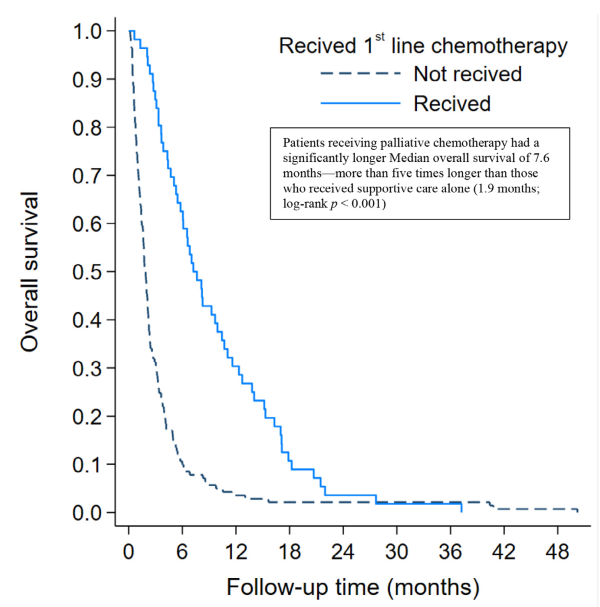
Results: A total of 212 patients with confirmed pancreatic cancer were included. The cohort was 55.2% male, and 59.9% were over 65 years old. Hospital case volume increased over the ten-year study period. The majority of patients (70.3%) presented with metastatic disease. First-line palliative chemotherapy was administered to 23.4% of patients, while 76.6% received best supportive care (BSC) alone. The overall one-year survival rate was 11.2%. Patients receiving palliative chemotherapy had significantly longer median overall survival (OS) than those receiving BSC alone (7.6 vs. 1.9 months, p < 0.001). Among chemotherapy regimens, FOLFIRINOX yielded a median OS of 17.7 months (95% CI: 10.5–35.8, p = 0.0008) compared to 6.0 months for single-agent gemcitabine. Multivariate logistic regression identified four independent predictors of one-year survival: ECOG performance status 0-1 (aOR = 6.82; 95% CI: 1.32–35.27, p = 0.022), receipt of first-line chemotherapy (aOR = 8.92; 95% CI: 2.78–28.64, p < 0.001), use of FOLFIRINOX (aOR = 12.9; 95% CI: 1.2–137.9, p = 0.034), and serum albumin ≥ 3.5 g/dL (aOR = 3.15; 95% CI: 1.45–6.85, p = 0.004).
Conclusion: The prognosis for locally advanced/unresectable and metastatic pancreatic cancer in this regional cohort remains poor, driven by late-stage diagnoses and a low utilization rate of palliative chemotherapy. However, achieving one-year survival is significantly predicted by favorable baseline health (ECOG performance status 0-1 and serum albumin ≥ 3.5 g/dL) and the receipt of first-line chemotherapy, particularly the FOLFIRINOX regimen. These quantitative findings underscore the critical need to overcome clinical and systemic barriers to administering combination chemotherapy to eligible patients to extend survival.
Downloads
Metrics
References
Khan A, Dhir M. Trends in the global incidence of pancreatic cancer and a brief review of its histologic and molecular subtypes. J Gastrointest Cancer 2025. PMID: 39992560.
Sun H, Ma H, Hong G, Sun H, Wang J. Survival improvement in patients with pancreatic cancer by decade: a period analysis of the SEER database, 1981-2010. Sci Rep 2014; 4: 6747. DOI: https://doi.org/10.1038/srep06747
Boulay BR, Parepally M. Managing malignant biliary obstruction in pancreas cancer: choosing the appropriate strategy. World J Gastroenterol 2014; 20: 9345-53.
Ioannou LJ, Ashika D, Zalcberg JR, Loughnan JT, Daniel G, Croagh DG. Prognostic models to predict survival in patients with pancreatic cancer: a systematic review. HPB (Oxford) 2022; 24:1201-16. DOI: https://doi.org/10.1016/j.hpb.2022.01.011
Wang D, Ma Z. Pancreatic cancer in highincome Asia-Pacific: a population-based study. Cancer Control 2025; 32. DOI: https://doi.org/10.1177/10732748251330713
de Jesus VHF, Mathias-Machado MC, de Farias JPF, Aruquipa MPS, Jácome AA, Peixoto RD. targeting KRAS in oancreatic ductal adenocarcinoma: The long road to cure. Cancers (Basel) 2023; 15: 5015. DOI: https://doi.org/10.3390/cancers15205015
Shaw V, Zhang B, Tang M, Peng W, Amos P, Cheng P. Racial and socioeconomic disparities in survival improvement of eight cancers. BJC Rep 2024; 2: 21. DOI: https://doi.org/10.1038/s44276-024-00044-y
Onyemkpa C, Dougherty D, Samat SH, Oyasiji T, McLeod M. Racial disparities in the treatment of pancreatic cancer: results from the analysis of a National Database. J Pancreatol 2023; 6: 151-57. DOI: https://doi.org/10.1097/JP9.0000000000000151
Kongkam P, Benjasupattananun P, Taytawat P, Navicharoen P Sriuranpong V, Vajragupta L. Pancreatic cancer in an Asian population. Endosc Ultrasound. 2015; 4: 56-62. DOI: https://doi.org/10.4103/2303-9027.151361
Mettu NB, Abbruzzese JL. Clinical insights into the biology and treatment of pancreatic cancer. J Oncol Pract. 2016; 12: 17-23. DOI: https://doi.org/10.1200/JOP.2015.009092
Baloyan E, Zohrabyan D, Safaryan L, Avagyan A, Harutyunyan L, Bardakhchyan V. Treatment and outcomes of pancreatic cancer in Armenia: a retrospective study from resource-limited settings. JCO Glob Oncol 2025; 11: e2400217. DOI: https://doi.org/10.1200/GO.24.00217
Aung MMT, Naing NN, Hassan MRA, Wan-Arfah N, Chan HK, Shah HH. Prognostic factors of the survival of pancreatic cancer patients in peninsular Malaysia: a survival analysis. Med J Malaysia 2025; 80:43-49.
Hayat U, Croce PS, Saadeh A, Desai K, Appiah J, Khan S. Current and emerging treatment options for pancreatic cancer: a comprehensive review. J Clin Med 2025; 14: 1129. DOI: https://doi.org/10.3390/jcm14041129
Grossberg AJ, Chu LC, Deig CR, Fishman EK, Hwang Wl, Maitra A. Multidisciplinary standards of care and recent progress in pancreatic ductal adenocarcinoma. CA Cancer J Clin 2020; 70: 375-403. DOI: https://doi.org/10.3322/caac.21626
de la Fouchardière C, Adham M, Marion-Audibert AM, Duclos A, Darcha C, Berthelet O. Management of patients with pancreatic ductal adenocarcinoma in the real-life setting: lessons from the French National Hospital Database. Cancers 2021; 13: 3515. DOI: https://doi.org/10.3390/cancers13143515
Conroy T, Desseigne F, Ychou M, Bouché O, Guimbaud R, Bécouarn Y. FOLFIRINOX versus gemcitabine for metastatic pancreatic cancer. N Engl J Med 2011; 364: 1817-25. DOI: https://doi.org/10.1056/NEJMoa1011923
Jang DK, Kim DU, Lee JW, Kim HJ, Lee YS. The trends and outcomes of initial palliative chemotherapy in patients with pancreatic cancer in Korea based on National Health Insurance Service data. J Clin Med 2024; 13: 3229. DOI: https://doi.org/10.3390/jcm13113229
Downloads
Published
How to Cite
Issue
Section
License
Copyright (c) 2026 Journal of Southeast Asian Medical Research

This work is licensed under a Creative Commons Attribution-NonCommercial-NoDerivatives 4.0 International License.
The Journal of Southeast Asian Medical Research will hold the copyright to all published articles. The publisher's production department handles copyright forms once a manuscript is accepted and scheduled for publication.